What’s the Difference? U.S. Schools, Colleges & Universities?
In the United States, the terms "school," "college," and "university" are often used interchangeably, but they refer to distinctly different educational institutions and levels of learning. A "school" broadly encompasses any establishment where education is provided, including primary and secondary institutions (such as elementary and high schools) as well as specialized training centers. This term can sometimes cause confusion when people discuss higher education, as it might imply that a "school" offers advanced degree programs, while in reality, many "schools" only prepare students for basic higher educational requirements or vocational training.
Step 1 of 3
Use of this form constitutes your agreement to our Terms of Use and Conditions.
Step 2 of 3
Step 3 of 3
Thank You!
Your information has been submitted successfully.
For more information, please review our Terms and Conditions.
On the other hand, "college" and "university" are more specific to higher education. In general, a college primarily offers undergraduate degrees, such as associate's and bachelor's degrees, and sometimes may include a focus on liberal arts or technical training. Colleges are often smaller in scope and may focus more on teaching than research, creating a learning environment that emphasizes direct interaction between students and faculty. Conversely, a "university" typically refers to larger institutions that offer both undergraduate and graduate degree programs, including master's and doctoral degrees. Universities often feature various colleges or schools within their structure, which may specialize in different fields, and they also tend to have a strong emphasis on research and innovation. Understanding these distinctions can help students and parents make informed choices when navigating the educational landscape in the U.S.

Educational terminology in the United States often blurs the lines between "school," "college," and "university," leaving many, especially international students, uncertain about where to begin their academic journey. This guide unpacks each term's definition, structure, and credentials, compares colleges and universities side by side, explains degree pathways, and offers targeted insights for international applicants. In the sections that follow, you'll discover:
- What "school" encompasses in K-12 contexts
- How colleges focus on undergraduate learning
- Why universities integrate research and graduate programs
- Key contrasts in size, offerings, funding, and campus life
- Guidance on selecting the right institution as an international student
- An overview of associate, bachelor's, graduate, and micro-credentials
- Snippet-ready answers to the most common questions
With this roadmap, navigating US education terminology becomes clear and actionable.
The American Education System: An Overview
This report provides a comprehensive overview of the American education system, including the different types of schools, colleges, and universities, and the degrees they offer. It also discusses the key differences between these institutions and how they affect international students.
U.S. Department of Education, Institute of Education Sciences, National Center for Education Statistics, (2023)
What Does "School" Mean in the USA Education System?
A school in the United States refers broadly to any institution offering formal instruction, from kindergarten through grade 12. It establishes foundational knowledge, social skills, and basic certifications—typically a high school diploma—that prepare students for higher education or vocational pathways. Schools operate under local districts and state regulations, ensuring consistent standards and accreditation across public, private, charter, and vocational settings. Understanding what constitutes a "school" lays the groundwork for distinguishing colleges and universities.
What Are the Different Levels of School in the US?
Schools are organized into three primary grade spans that reflect developmental stages:
- Elementary School (K–5/6): Early literacy, numeracy, and foundational sciences form the core curriculum.
- Middle School (6–8): Students transition into subject-specific learning with exploratory electives.
- High School (9–12): Advanced coursework, standardized testing preparation, and elective specializations lead to a high school diploma.
Elementary tasks build reading and math fluency that middle school refines, which then propels high school students toward college readiness.
What Types of Schools Exist in the USA?
US schools vary by governance and mission, each offering tailored environments and resources:
- Public Schools: Funded by local taxes, open to all residents, governed by elected school boards.
- Private Schools: Independent funding and tuition-based operations, often with religious or pedagogical missions.
- Charter Schools: Publicly funded but privately managed, with flexible curricula in exchange for accountability.
- Vocational/Technical Schools: Career-focused training in trades like automotive tech, culinary arts, or healthcare.
These models provide diverse learning contexts that shape academic preparation and next-step decisions.
How Does K-12 Education Fit into the School System?
K-12 designates the entire span from kindergarten (K) through 12th grade, encompassing elementary, middle, and high schools under a unified framework. State departments set learning standards for each subject and grade, while local districts implement curricula, assessments, and graduation requirements. K-12 schooling culminates in a high school diploma, which serves as the foundational credential for college admissions or vocational certification pathways.
What Credentials Do Schools Provide?
Schools primarily award the High School Diploma, signaling completion of secondary education and eligibility for post-secondary studies. In some jurisdictions, additional credentials include:
- GED Certificate: An alternative diploma for students who complete a standardized equivalency exam.
- Career Certificates: Industry-recognized credentials from vocational schools validating skill proficiency.
With these credentials secured, students transition into colleges, universities, or the workforce.
Having defined the scope of schools, we can now examine how colleges serve students beyond secondary education.
What Defines a "College" in the USA?
A college in the US typically refers to an institution offering post-secondary undergraduate programs—namely associate's and bachelor's degrees—focused on teaching and practical skills. Colleges may stand alone or form part of a larger university structure. They emphasize smaller class sizes, direct faculty-student interaction, and often serve regional or community needs. Recognizing this focus on undergraduate education clarifies how colleges differ from both K-12 schools and research-oriented universities.
What Types of Colleges Are There in the US?
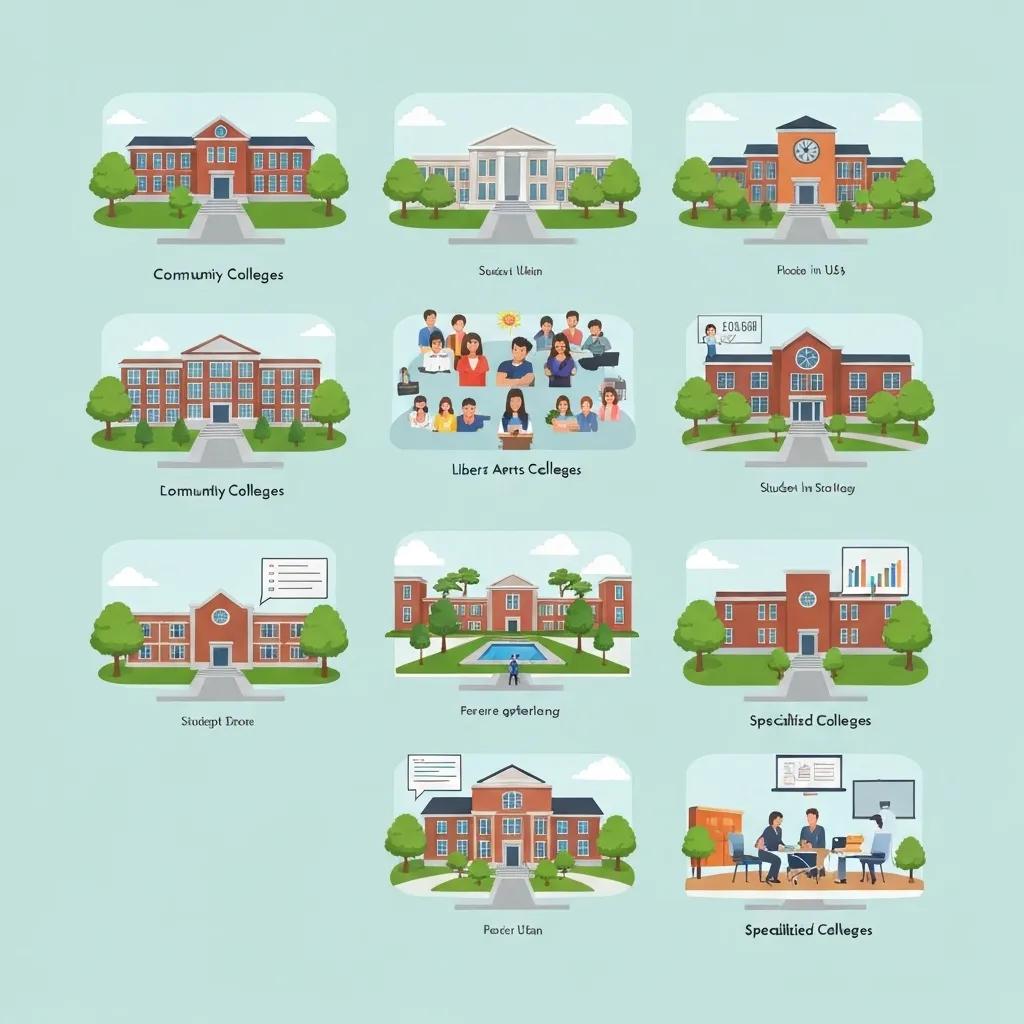
Colleges come in several distinct forms tailored to academic and career goals:
- Community Colleges: Two-year institutions offering associate's degrees and transfer pathways to four-year programs.
- Liberal Arts Colleges: Four-year schools emphasizing broad-based humanities and sciences curricula leading to a bachelor's degree.
- Two-Year vs. Four-Year Colleges: Two-year colleges award associate's degrees; four-year colleges grant bachelor's degrees, with a more extensive array of majors and electives.
- Specialized Colleges: Institutions focused on fields like art, music, or technology that deliver niche undergraduate training.
Each type balances affordability, program length, and academic breadth to meet diverse student objectives.
What Degrees Do Colleges Offer?
Colleges grant two primary credentials:
| Program Type | Degree Conferred | Typical Duration |
|---|---|---|
| Associate's Program | Associate's Degree | 2 years |
| Bachelor's Program | Bachelor's Degree | 4 years |
Associate's degrees often enable quick entry into technical roles or serve as stepping stones to bachelor's programs. Bachelor's degrees prepare students for professional careers or graduate study.
How Do Colleges Differ from Universities in Size and Focus?
Unlike universities, which may enroll tens of thousands across multiple schools, most colleges remain smaller in both campus footprint and student population. This scale enhances personalized teaching, focused career advising, and tight-knit campus communities. Colleges prioritize instructional quality and undergraduate experience, whereas universities combine teaching with extensive research agendas. The college model thus appeals to learners seeking concentrated academic mentorship.
Can Colleges Offer Graduate Degrees?
Yes, exceptions exist. Some institutions bearing "college" in their name, such as Boston College, award master's and doctoral degrees within select graduate schools. However, these cases are specialized outliers; the vast majority of colleges concentrate exclusively on undergraduate programs. Recognizing these exceptions prevents confusion when evaluating an institution's degree offerings.
Understanding how colleges position themselves leads naturally to exploring the comprehensive role of universities in US higher education.
How Is a "University" Different in the USA?
A university in the United States is a post-secondary institution that encompasses both undergraduate and graduate education, often organized into multiple colleges or schools (e.g., College of Engineering, School of Business). Universities maintain robust research programs, attract external funding, and issue master's, doctoral, and professional degrees. Their scale and resources foster innovation, advanced scholarship, and a wider range of academic offerings compared to colleges.
What Types of Universities Exist in the US?
Universities vary by funding, mission, and prestige:
- Public Universities: State-funded institutions with large undergraduate and graduate enrollments.
- Private Universities: Tuition-dependent with endowments; often smaller but resource-rich.
- Research Universities: Emphasize faculty research output, doctoral programs, and laboratory infrastructure.
- Teaching-Focused Universities: Prioritize undergraduate instruction over extensive research.
- Ivy League Universities: A historic consortium of elite private universities noted for academic rigor and selective admissions.
These categories reflect differences in governance, emphasis on research, and student demographics.
What Degree Levels Do Universities Offer?
Universities award a full spectrum of credentials across degree levels:
- Bachelor's Degrees: Four-year undergraduate programs across disciplines.
- Master's Degrees: Specialized graduate studies, typically 1–2 years beyond a bachelor's.
- Doctoral Degrees (Ph.D., Ed.D., etc.): Advanced research credentials requiring original scholarship and dissertations.
This breadth enables universities to support lifelong learning from entry-level undergraduate through highest-level academic inquiry.
How Are Universities Structured?

Universities comprise multiple sub-units—colleges or schools—each responsible for particular disciplines:
- College of Arts & Sciences
- School of Medicine
- College of Engineering
- Graduate School
This federated model allows specialized governance, tailored curricula, and dedicated faculty teams, all under the overarching university administration. Such structure supports coordination across diverse academic areas.
What Role Does Research Play at Universities?
Research at universities drives innovation, secures grants, and enriches teaching with cutting-edge discoveries. Faculty and graduate students contribute peer-reviewed publications, patents, and community partnerships.
This research focus fosters an environment where inquiry informs instruction, preparing undergraduates and postgraduates to engage with real-world challenges. Understanding this research emphasis distinguishes universities from colleges centered solely on instruction.
Having outlined the defining features of schools, colleges, and universities, we now turn to a side-by-side comparison of colleges and universities in America.
What Are the Key Differences Between Colleges and Universities in America?
While both colleges and universities provide post-secondary education, they differ in mission, scale, degree breadth, and resources. The table below highlights these contrasts:
| Attribute | College | University |
|---|---|---|
| Student Population | Smaller (hundreds–few thousands) | Larger (thousands–tens of thousands) |
| Degree Levels | Associate's & Bachelor's | Bachelor's, Master's, Doctoral |
| Research Emphasis | Limited to none | Significant, with dedicated research centers |
| Campus Structure | Single academic unit | Multiple colleges/schools |
| Faculty Roles | Primarily teaching | Mix of teaching and research |
| Funding Sources | Tuition and local support | State/federal funds, endowments, grants, tuition |
This direct comparison clarifies why a student's choice between a college and a university hinges on desired degree level, campus experience, and research opportunities.
How Do Colleges and Universities Compare in Size and Campus Life?
Colleges often foster tight communities with smaller class sizes, easy faculty access, and a focus on undergraduate programming. Universities offer expansive campuses with diverse student organizations, research labs, graduate communities, and broader cultural events. Prospective students should weigh the intimacy of college life against the vibrancy and scale of university campuses.
What Are the Differences in Degree Offerings?
Colleges restrict credentials to associate's and bachelor's degrees, suitable for many professional fields and transfer pathways. Universities extend offerings to master's and doctoral programs, enabling advanced specialization and academic careers. Those planning research-oriented or academic roles typically pursue university degrees.
How Do Costs and Funding Differ Between Colleges and Universities?
Public colleges and universities offer lower in-state tuition, but out-of-state rates and private institution costs can vary widely. Universities may provide substantial graduate assistantships and research fellowships, whereas colleges rely more heavily on tuition revenue. Financial aid packages also differ, with universities often possessing larger endowments to underwrite scholarships.
What Are Common Exceptions and Terminology Confusions?
Several institutions named "college" function as universities, offering graduate degrees (e.g., Boston College, Dartmouth College). Conversely, some small private universities maintain "university" titles despite limited research activity. Recognizing these naming anomalies requires reviewing each institution's degree catalog.
With institutional distinctions clear, international students face unique considerations when selecting US schools, colleges, and universities.
How Do These Differences Affect International Students Choosing US Institutions?
International applicants must decode US terminology to align academic objectives, application requirements, and visa processes. Whether seeking a vocational route after high school or advanced research opportunities, understanding each institution type's focus ensures successful admissions and cultural adjustment.
Higher Education in the United States: A Guide for International Students
This guide offers insights into the US higher education system, including application processes, visa requirements, and cultural adjustments for international students. It also provides information on different types of institutions and degree programs.
IIE (Institute of International Education), Open Doors Report (2024)
What Should International Students Know About US Education Terminology?
Terms like "college," "university," and "school" carry different connotations abroad. In many countries, "college" refers to secondary education, whereas in the US it implies undergraduate study. Clearing these semantic differences helps international learners target appropriate programs and avoid misapplications.
How Do Application and Visa Processes Differ by Institution Type?
Colleges (Associate's/Bachelor's): Applications require high school transcripts and standardized tests (SAT/ACT). Visa category: F-1 student visa.
Universities (Graduate): Applications demand undergraduate transcripts, letters of recommendation, and possible GRE/GMAT scores. Visa: F-1 or J-1 exchange visa.
Graduate research positions often include assistantships that sponsor parts of tuition and living stipends, affecting financial documentation for visa approval.
What Cultural Adjustments Are Needed When Attending US Schools, Colleges, or Universities?
International students adapt to classroom participation expectations, independent study models, and campus social norms. K-12 schools may emphasize parent-teacher communication, whereas colleges and universities value self-advocacy and academic integrity. Orientation programs and cultural exchange clubs facilitate smoother transitions.
How Can International Students Choose the Right Institution for Their Goals?
- Undergraduate Aspirants: Evaluate community colleges for affordability and transfer options or liberal arts colleges for personalized mentoring.
- Graduate Seekers: Target research universities offering funded assistantships and areas of faculty expertise.
- Vocational Pathways: Consider technical schools for hands-on training and rapid workforce entry.
Aligning program structure, degree level, and campus culture with personal objectives leads to an informed decision.
What Are the Main Types of Degrees in the US Education System?
US degrees span from short-term credentials to the highest academic honors, each serving distinct career and educational aims. Knowing where and how these credentials are awarded informs pathway planning.
What Is an Associate's Degree and Where Is It Offered?
An associate's degree, awarded mainly by community colleges and vocational schools, typically requires two years of study. It grants foundational knowledge for technical careers or seamless transfer to four-year bachelor's programs. This credential is valuable for cost-effective skill acquisition and workforce entry.
What Is a Bachelor's Degree and Its Typical Providers?
A bachelor's degree, offered by four-year colleges and universities, involves 120 credit hours across general education, major requirements, and electives. It prepares graduates for professional roles, licensure pathways, and eligibility for graduate study in fields ranging from business to engineering.
What Graduate Degrees Are Available at Universities?
Universities award advanced degrees that elevate expertise and research capability:
- Master's Degrees: Focused on specialized skills, research projects, or professional practice (e.g., M.A., M.S., M.B.A.).
- Doctoral Degrees: Highest academic credentials involving original research (e.g., Ph.D., Ed.D.).
Graduate credentials open doors to leadership positions, academic careers, and specialized industry roles.
How Do Certificates and Micro-Credentials Fit Into the System?
Short-term certificates and micro-credentials offered by colleges and universities supplement degrees with targeted skills in areas like data analytics, project management, and digital marketing. They typically require weeks to months of focused coursework and serve professionals seeking upskilling without full degree commitment.
With an understanding of institutional types and degree options, we now address the most frequently asked questions about schools, colleges, and universities in the USA.
What Are Common Questions About Schools, Colleges, and Universities in the USA?
Is a College Part of a University?
Some colleges operate as subdivisions within universities (e.g., College of Engineering at State University), while many standalone colleges function independently without graduate programs. Understanding an institution's charter clarifies whether "college" denotes a department or an entire campus.
Can Colleges Offer Master's Degrees?
Yes, a small number of colleges bearing "college" in their title—such as Boston College—maintain accredited graduate schools that grant master's and doctoral degrees. However, this remains an exception rather than the norm.
What Is K-12 Education?
K-12 education encompasses kindergarten through 12th grade, covering all primary and secondary schooling in the US. It culminates in a high school diploma or equivalent certification and constitutes the preparatory stage before college or vocational training.
Are Community Colleges Considered Universities?
Community colleges are not universities; they focus on two-year associate's programs and transfer pathways. Universities offer broader degree ranges, including advanced graduate degrees and research opportunities.
How Do Public and Private Institutions Differ?
Public institutions rely on state funding and lower in-state tuition, while private schools depend on endowments and tuition revenues, often resulting in higher sticker prices. Private colleges may offer more generous financial aid, and public universities may have larger student bodies and extensive research portfolios.
With these answers in hand, you're equipped to navigate the nuances of US educational terminology and choose the best path for your academic and career goals.
Frequently Asked Questions
What are the benefits of attending a community college in the USA?
Community colleges offer several advantages, particularly for students seeking affordable education. They typically have lower tuition rates compared to four-year institutions, making them an economical choice for obtaining an associate's degree. Additionally, community colleges often provide flexible schedules, allowing students to balance work and study. Many also have transfer agreements with universities, facilitating a smooth transition to a bachelor's program. This pathway can be especially beneficial for students who may not be ready for a four-year college experience right away.
How do international students apply to US colleges and universities?
International students typically need to follow specific application procedures when applying to US colleges and universities. This includes submitting academic transcripts, standardized test scores (like the SAT or ACT for undergraduate programs), and proof of English proficiency (such as TOEFL or IELTS scores). Additionally, students may need to provide letters of recommendation and personal statements. It's crucial to check each institution's requirements, as they can vary significantly. Understanding visa requirements and financial documentation is also essential for successful admission.
What is the significance of accreditation for US educational institutions?
Accreditation is a critical factor in the quality and recognition of educational institutions in the US. It ensures that schools, colleges, and universities meet specific standards of education set by recognized accrediting bodies. Attending an accredited institution is essential for students, as it affects the transferability of credits, eligibility for federal financial aid, and the value of the degree in the job market. Prospective students should always verify an institution's accreditation status before enrolling to ensure they receive a quality education.
What role do extracurricular activities play in US colleges and universities?
Extracurricular activities are an integral part of the college experience in the US, contributing to personal development and community engagement. Participation in clubs, sports, and organizations helps students build leadership skills, make friends, and enhance their resumes. Many colleges encourage involvement in extracurriculars as they can provide networking opportunities and foster a sense of belonging on campus. Additionally, these activities can be beneficial for students' mental health, offering a balance to academic pressures and promoting a well-rounded college experience.
How do financial aid options differ between colleges and universities?
Financial aid options can vary significantly between colleges and universities. Generally, universities may have larger endowments and more extensive financial aid programs, including grants, scholarships, and assistantships for graduate students. Colleges, particularly community colleges, often focus on providing affordable tuition and may offer fewer financial aid resources. However, both types of institutions can provide federal and state financial aid, and students are encouraged to complete the FAFSA (Free Application for Federal Student Aid) to explore available funding options regardless of the institution type.
What should students consider when choosing between a college and a university?
When deciding between a college and a university, students should consider several factors, including their academic goals, desired degree level, and campus environment. Colleges typically focus on undergraduate education and may offer smaller class sizes, which can enhance personalized learning. In contrast, universities provide a broader range of degree options, including graduate programs and research opportunities. Students should also evaluate the campus culture, available resources, and financial implications to ensure their choice aligns with their educational and career aspirations.
Conclusion
Understanding the distinctions between schools, colleges, and universities in the USA is crucial for making informed educational choices. Each institution type offers unique pathways, from foundational K-12 education to advanced graduate studies, catering to diverse academic and career aspirations. By clarifying these terms, international students can better navigate their options and align their goals with the right institution. Explore our resources to further enhance your educational journey in the United States.

Study in the USA®
Get matched to the best program for you
Let us know what you're looking for so we can find the best school for you.

Useful Articles



Check Out These Schools

English Language Institute at Michigan Technological University
$5,000—$10,000 Semester

Arkansas Tech University
$10,000 — $15,000 Semester
Sam Houston State University - Office of International Programs
$5,000—$10,000 Semester

The Fashion Institute of Technology (FIT)
Typical cost per Session: $1,000—$2,000

Santa Barbara City College
Typical cost per Year: $5,000—$10,000
Elgin Community College
Typical cost per Year: $5,000—$10,000




Start your U.S. adventure with Study in the USA

Learn About U.S. education financing, housing, and more
The Michigan English Test for Higher Education Admissions in the U.S.
College can be hard. Proving your English doesn’t have to be. The Michigan English Test (MET) assesses your English skills, not your test-taking skills. When it’s time to prove your English, MET is the only test you need.

TutorABC
Ready to take your language learning to the next level? Have you heard about TutorABC, the World's No. 1 Online Platform for Learning English and Chinese? TutorABC is recognized as the top language platform, harnessing innovative technology to offe...
TestDEN Ultimate TOEFL Test Prep Online Course
TestDEN's Online TOEFL Test Prep is just what you need to quickly and effectively prepare for the TOEFL test. Since 1998, TestDEN has helped tens of thousands of students raise their TOEFL scores.
Resources
Learn about American culture and education direct from our experts at Study in the USA. Read more